

Jahangir Mohammed calls on Muslims to rethink their activities and strategies in the face of a rising tide of anti-Muslim hatred.
Across the Western world, Muslims have long faced hostility from far-right, neoconservative, white nationalist groups, and Israel-supporting organisations. The typical Muslim response, driven by the noble desire to show civility, charity, and peace, has often been to counter hate with compassion, reaffirming the goodness and peaceful nature of Islam. However, Muslims should understand a harsh reality: propaganda aimed at demonising and criminalising a people cannot be undone by demonstrating piety and goodness. Even worse, attempts to “perform peacefulness” in the face of deep-seated hatred may unintentionally reinforce the very narratives used to vilify Muslims (a kind of appeasement).
Islamophobia Is Not a Phobia
The term “Islamophobia” is misleading. By framing anti-Muslim hatred as a phobia, it implies an irrational fear, something that can be cured by reassurance, understanding or education.
But hostility towards Muslims is not merely a personal mental quirk; it is a coordinated political campaign. It signifies ideological and political warfare, expressed through propaganda in politics and media, policies, and violence. It is not driven by fear of Muslims. Instead, it is about control, exclusion, dominance, and erasure. Labelling it a “phobia” risks minimising its systemic, deliberately political, and organised nature.
The Limits of Borrowed Anti-Racism Strategies
Much of traditional anti-Islamophobia activity has followed the model established by the wider race relations industry. These anti-racism strategies originate from the mid-to-late 20th century, when the focus was on exposing ignorance and reducing bigotry through education. Activities involved raising awareness of racism, organising interfaith/cultural events, educating the public to ‘unlearn’ prejudices, recruiting a more representative workforce, and greater engagement in parliamentary politics.
That approach has failed to address anything beyond superficial racial prejudice, which is now resurgent. While these methods may have a function, they are not enough to combat the modern, weaponised propaganda against Muslims. Nor can that challenge be met simply through a definition or by politicians. Today’s anti-Muslim hatred is not caused by ignorance; it is driven by ideology, political opportunism, and strategic disinformation. Trying to ‘educate away’ hate assumes a neutrality in public discourse that no longer exists; it is a relic of a bygone era. We are no longer facing a knowledge gap, but a spread of hostile narratives supported by powers actively at war with Muslim communities.
The Mechanics of White Nationalist Propaganda
Far-right or white nationalist movements in the US, UK, and across Europe thrive on caricatures of Muslims as violent, subversive, and foreign. These groups, whether street-level mobs or political parties, dislike Muslims not only for their actions but also for what they are falsely portrayed to represent: a threat to “Western civilisation.” This propaganda has specific traits: whilst being overtly a form of religious hatred, at times it can take the form of racial hatred even when it claims otherwise. It distorts concepts like taqiyya to depict Muslims as deceptive. It dismisses or reinterprets Muslim condemnations of violence as untrustworthy. It utilises media amplification and disinformation to instill and reinforce prejudice, and to create mood music for violence.
The Southport Mosque Attack: When the Hate Becomes a Pogrom.
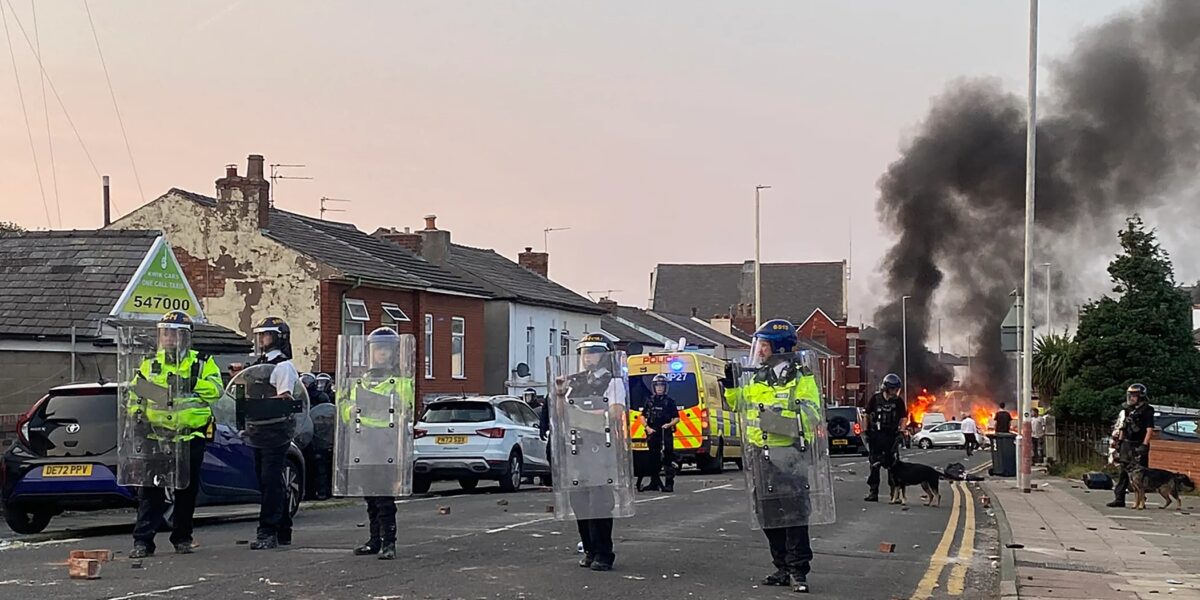
The attacks on the Southport Mosque in 2024 sparked violent assaults on Muslims and refugees throughout Britain. These were not isolated incidents but rather a sign of more profound, growing hostility and hatred against Muslims. Nationalist rhetoric, influencers, and social media provocations incited the rioters. Crowds targeted Muslim neighbourhoods, attacked property, and threatened Muslim residents. This marked the beginning of pogroms against Muslims in Britain and served as a warning of what could be waiting ahead unless the Muslim community becomes organised.
Following the attacks, many Muslim leaders, particularly some local imams, responded with restraint. They urged calm, reminded their congregations of Islamic values like mercy and patience, and encouraged their communities not to retaliate. They promoted dialogue and even distributed food. However, their restraint was exploited. Nationalist media used their statements not to highlight Muslim civility but to reinforce the idea that Muslims “shouldn’t provoke” white nationalism. Their peace was seen not as a sign of strength but as a symbol of weakness.
The Pro-Israeli Anti-Muslim Propaganda Front
In recent years, pro-Israel propagandists have intensified their efforts to associate Muslims, Palestinians, and their supporters with terrorism, antisemitism, and a civilisational threat. This propaganda is deeply rooted in Western politics and media, where Muslim protests and political dissent are smeared and criminalised. At the same time, Israeli aggression and violence are sanitised and protected, using the charge of antisemitism and hate.
In this environment, the Muslim instinct is often to demonstrate their peaceful intentions: to say, “We do not support Hamas,” or “We only want peace.” However, these declarations are usually ignored by a media system that refuses to hear them, or worse, distorted as strategic lies.
Muslims are told to condemn “terrorism,” even when they have already done so tirelessly. They are advised to distance themselves from Palestine, even when they or their families, and co-religionists are victims of its occupation. The propaganda demands a self-erasure in the name of public relations.
Hindutva Activism: A Third Anti-Muslim Front.
Muslims also need to recognise the increasing threat of Hindutva propaganda, which targets Muslims not only in India but increasingly around the world. This fascist nationalist ideology, based on Hindu supremacy, spreads harmful myths about Islam, incites mob violence, and promotes anti-Muslim narratives through digital platforms and diaspora networks.
Hindutva propaganda has actively allied with far-right and Israeli disinformation campaigns. Together, they shape global narratives portraying Muslims as threats to civilisation, democracy, and the West. Once again, our collective response has often been to retreat into symbolic gestures, calls for peace, interfaith smiles, or generic condemnations—rather than launching a coordinated, strategic political resistance.
The Performance of Peacefulness
There is a growing pattern in the Muslim response to hatred: to prove innocence through hyper-visibility in good deeds. Muslims are organising food banks, interfaith dinners, peace walks, and anti-extremism campaigns. These acts reflect genuine Islamic values—but they are also a performance meant to appease an audience that has no intention of being appeased.
The expectation that Muslims must constantly prove their humanity—by being model citizens, smiling imams, silent victims—is exhausting. And it is ineffective against a machine built to deny Muslim humanity and rights in the first place.
Charity-Rich, Politics-Poor: A Dangerous Imbalance
The Muslim community has invested in mosques and humanitarian charities but remains heavily under-represented in independent political organisations and think tanks that are not connected to party politics. Ayaan’s report, “Aiding the Ummah,” identified 1,026 Muslim international humanitarian charities and 2,752 mosques and prayer houses. Muslims contribute more to charity per capita than almost any other group in the UK. Mosques operate food banks, refugee aid programmes, and community health services. These actions are commendable and rooted in the Prophetic tradition of serving others. Likewise, Muslim philanthropists prioritise charities, mosques, and organisations linked to party politics. However, charities, mosques, good works, and party politics on their own will not protect a community under siege.
The lack of a strong independent community political infrastructure (advocacy groups, think tanks, defence organisations/funds, and media platforms) means Muslims often enter public and political discourse at a disadvantage, unprepared, and reactive. Where there should be think tanks, there are humanitarian aid organisations, mosques, and soup kitchens. Where there should be strategists and critical political thinkers, there are merely volunteers. Where there should be independent political mobilisation, there is an overattachment and reliance on the politicians of a political party. This imbalance leaves the Muslim community vulnerable to propaganda hate campaigns that it cannot sufficiently counter.
In comparison, in 2020, Ayaan Institute analysed 584 primarily UK-based Jewish charities. The contrast is striking. Only 1% (5) of the charities focused on humanitarian aid. Meanwhile, 10% (57) engaged in Israel advocacy or were linked to Israel. There was a significantly wider range of charity investments in children and young people, at 9% (54), and in education and training, at 8% (48), which were priorities. Religious charities constituted just 4% (22). Overall, a broader variety of charity types (23) addressed the diverse needs of the community, despite representing a small minority.
We Must Change
Piety is not a sign of weakness. But neither is propaganda simply a result of ignorance. It is a weapon. And weapons must be disarmed, not reasoned with. We must develop the appropriate tools to protect the Muslim community from threats that have been adequately identified. That means investing in the right types of activity.
A more effective Muslim response should include: –
- Independent Political Development and Courage: A politics that is not imprisoned by party political language, analysis, and media framing. Naming hate and violence for what it is and refusing to apologise for one’s identity.
- Grassroots Coalitional Power: Mobilising ourselves and other minority and religious/local communities, indigenous movements, and other marginalised groups to build resistance.
- Media Presence: Reclaiming narratives through Muslim-owned platforms, social media, and other means.
- Strategic Resistance: Moving beyond moral appeals to actual power-building, including legal challenges, organising, public challenges and disruption where necessary.
Conclusion: Love Alone Is Not Enough
Islam is a religion of mercy, justice, and beauty. However, the Qur’an does not simply ask believers to be kind in the face of oppression. It urges us to stand firmly for justice, “even if it is against yourselves” (Qur’an 4:135). We are also instructed to defend ourselves against oppression through our actions, words, and even in our hearts, depending on the circumstances. You cannot defeat propaganda with piety alone, especially when that propaganda is designed to turn your piety into weakness. To respond effectively to a world that seeks to erase or redefine Muslims, the answer lies not in trying to prove we are lovable, but in demonstrating we can defend ourselves politically and cannot be erased.
Leave a Reply