

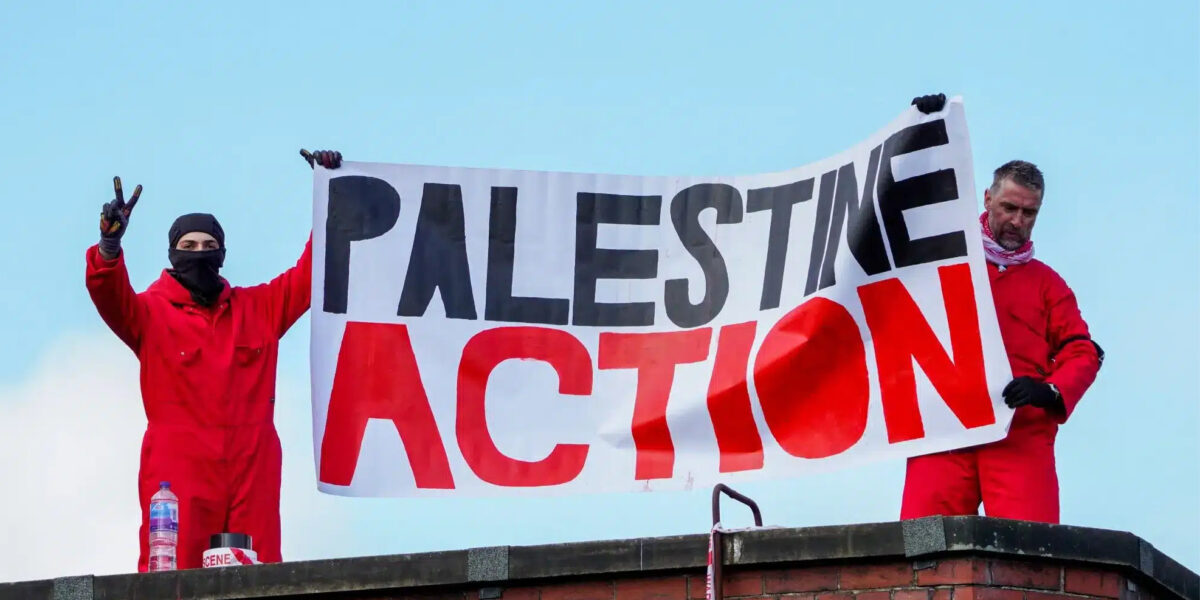
Jahangir Mohammed of the Ayaan Institute argues that, considering the fiasco surrounding the proscription of the Palestine Action Group as a terrorist organisation, with subsequent protests and arrests, there is a need to review the proscription process. He advocates for a shift away from the Home Secretary and Parliament, who can be influenced by political lobbying, towards a transparent and independent Judicial process. He has written an open letter to the Home Secretary to make the case.
Who Decides Who is a Terrorist Group: The Case for Taking UK Proscription Power Out of the Home Secretary’s Hands
The recent proscription of the group Palestine Action as a terrorist organisation, and the subsequent civil disobedience protests deliberately breaking what is widely seen as an unjust law, with large-scale arrests, have cast a shadow on the credibility of the terrorist proscription process.
Britain has proscribed ninety-one organisations as terrorists. Of these, seventy-seven are Muslim or based in Muslim countries. Many of these groups pose no threat of violence or harm to the United Kingdom. Most do not even target the UK. Numerous groups have been on the proscribed list for years without review. Yet groups in countries considered allies of Britain that engage in violence against civilians, such as the RSS in India or Jewish settler groups in Israel, both of which have links to the UK, have never been proscribed.
The power to proscribe an organisation as a terrorist is one of the most severe powers any government can wield. It has profound consequences even for those who may express support for the group recklessly. In the United Kingdom, this power resides entirely in the hands of the Home Secretary and Parliament (with the aid of a cross-government Proscription Review Group). Under the Terrorism Act 2000, the Home Secretary can proscribe a group if he or she believes it is “concerned in terrorism,” a decision Parliament typically rubber-stamps as a formality. Once banned, it becomes a criminal offence to be a member, support, promote, or glorify the group, or even display its symbols.
However, this system, based on executive discretion, faces increasing criticism for lacking due process, being susceptible to political influence, and potentially undermining core democratic freedoms. This article contends that the UK’s proscription regime urgently needs reform to establish robust judicial oversight, aligning it with international standards of justice and the rule of law.
The Flawed Status Quo: Executive Power Without Check
The current process is starkly one-sided. The Home Secretary, relying on intelligence and policy advice, makes the decision to outlaw a group without any obligation to notify the organisation or grant it a hearing beforehand. The decision is often justified by classified evidence, leaving the public and the targeted group in the dark. The only recourse is a slow and difficult appeal to the Proscribed Organisations Appeal Commission (POAC) after the ban has taken effect, by which time the group’s activities are already criminalised and its members are subject to arrest. This also means that lawyers and advocates for the appeal can be smeared as supporters of terrorism.
This “set and forget” approach has led to a bloated list of ninety-one international terrorist organisations, including a diverse range of groups from those described as “Islamist” factions like Hamas to the Russian mercenary Wagner Group. Groups often remain proscribed indefinitely, even if they have long ceased to exist or pose a threat, as the law appears to provide no mechanism for automatic review. Successive Independent Reviewers of Terrorism Legislation have highlighted this, noting that maintaining outdated listings is an “affront to the rule of law.” The onus rests on the banned group to prove its innocence, rather than on the state to justify the ongoing necessity of the ban periodically.
The Dangers of Politicisation: Lobbying Over Evidence
Perhaps the most significant flaw is the system’s vulnerability to political pressure and lobbying. Because the decision is ultimately political, it can be influenced by foreign governments, geopolitical interests, and domestic advocacy groups rather than an objective threat assessment.
Several current cases highlight this danger:
- Hezbollah: For years, the UK distinguished between the group’s military and political wings. The 2019 decision to ban the entire organisation followed what one lobbyist openly called “pure lobbying” by pro-Israel groups within Westminster.
- Hamas: The history of Hamas’s proscription illustrates how political attitudes shift over time. Its military branch was banned in 2001, but its political branch remained lawful in the UK for twenty years. The decision to ban all of Hamas in 2021, although announced for national security reasons, was widely viewed through a geopolitical perspective. Critics contended there was no clear assessment of whether the political branch’s activities in the UK posed a terrorism threat; instead, the decision seemed driven by diplomatic pressure and a desire to align with international allies, showing how proscription can function as a foreign policy instrument.
- Hizb ut-Tahrir: This organisation, which calls for a global caliphate but claims to eschew violence, had long been controversial, and its banning had been debated since 2005. The Government had previously concluded there was insufficient evidence of terrorist activity to justify proscription. However, it was suddenly banned in January 2024, with the government citing its glorification of Hamas’s October 2023 attacks as evidence that it was “concerned in terrorism.” While its rhetoric was considered extreme, many saw the ban as politically motivated, coming in the heated climate after the Israel-Hamas attacks, and a stark example of the blurred line between controversial/extreme speech and terrorist action being decided by official interpretation.
- Palestine Action: The 2025 proscription of this domestic protest group has marked a seismic shift. The group engages in deliberate criminal damage and trespass against arms companies but does not target human life. Legal scholars decried the ban as a collapse of the distinction between terrorism and civil disobedience, warning of a chilling effect on legitimate protest.
- The Wagner Group: The proscription of this Russian private military company illustrates how the process can also be used to respond to state-level threats and geopolitical aggression. While its activities undoubtedly posed a security risk, the decision-making process behind its listing remained as opaque and executive-led as the others, subject to the same lack of preliminary judicial scrutiny.
- The Muslim Brotherhood: While not banned, the UK commissioned a review of the group after allies like Saudi Arabia and the UAE threatened to cancel lucrative arms deals unless action was taken. The review found insufficient evidence to justify proscription, but the episode revealed how foreign powers can attempt to leverage trade to influence the UK’s terror list. There is now intense political lobbying to proscribe the group again.
These examples share a common thread: decisions were made by a minister responding to political currents without a transparent, judicial weighing of evidence. This erodes trust and risks transforming proscription from a national security tool into a tool of political convenience.
The Imperative for Judicial Oversight and Due Process
Designating an organisation as a terrorist criminalises guilt by association and can shut down political or religious groups overnight. Such a grave power demands scrupulous fairness and objectivity. Introducing a judicial or quasi-judicial process would bring multiple benefits:
- Impartiality: A committee of judges would be insulated from day-to-day political lobbying, basing decisions on evidence and law rather than diplomatic expediency.
- Evidence-Based Decisions: The current system requires the Home Secretary’s “belief.” A judicial process would demand that the authorities present facts and intelligence to substantiate the claim of terrorist involvement, preventing bans based on mere rhetoric or unpopular ideology.
- Transparency and Accountability: Hearings, even partially closed, would allow for a tested, adversarial process. The use of special advocates to handle sensitive material would protect security while ensuring the group’s interests are represented. A reasoned, public decision would then explain the ban, boosting public confidence.
- Protecting Rights: Judges are tasked with weighing proportionality and necessity, ensuring that proscription does not unjustly infringe on freedoms of expression and association. This check is crucial to prevent the criminalisation of peaceful dissent.
- Resilience Against Pressure: An independent body would be far less susceptible to lobbying by interest groups or pressure from foreign states, ensuring designations are based on objective threat assessment, not political favour.
Learning from International Best Practice
The UK does not need to invent a new system from scratch. Several allied countries demonstrate how to balance security with due process:
- Periodic Reviews: The United States mandates a review of each Foreign Terrorist Organisation listing every five years, while Canada requires a review of the complete list every two years. New Zealand imposes a default three-year limit on designations, forcing the government to justify an extension in court.
- Judicial Confirmation: In New Zealand, the Prime Minister’s initial designation is only temporary; to make it permanent, the government must seek approval from the High Court. India uses a tribunal headed by a high court judge to review the government’s decision to ban an organisation.
- Robust Appeals: In the US and EU, groups can challenge their designations in court. EU courts have annulled listings for due process flaws, forcing authorities to improve their procedures and evidence.
- UN Ombudsperson: At the international level, the UN Security Council’s Ombudsperson provides an independent review for individuals and groups on its sanctions list. The Council has never overruled a recommendation to delist, injecting fairness into a previously opaque process.
A Proposal for a New UK Mechanism
Drawing on these models, the UK should establish a new, fairer proscription process centred on an Independent Proscription Commission—a judicial panel of security-cleared judges.
The reformed mechanism would work as follows:
- Application, Not Decree: The Home Secretary must apply to the Commission to ban a group, presenting evidence to support the case.
- Right to a Hearing: The targeted organisation would be notified and given the opportunity to contest the application through legal representation, using closed material procedures where necessary to protect sensitive intelligence.
- Judicial Decision: The Commission would issue a public, reasoned decision on whether the legal test is met and if the ban is proportionate.
- Refocused Parliamentary Role: Parliament would debate and approve the ban based on the Commission’s findings, not the executive’s unilateral decision.
- Sunset Clause and Review: Proscription orders would expire after a set period (e.g., three years), forcing the government to justify a renewal. Groups could also petition for de-proscription at any time based on new evidence.
Conclusion
The UK’s current proscription regime concentrates vast power in the executive with few checks, increasingly conflicting with the rule of law. The outcomes include questionable bans—from the lobbying-driven banning of Hezbollah, Hamas, and the politically timed ban on Hizb ut-Tahrir, to the unprecedented proscription of Palestine Action—which exposes susceptibility to foreign influence and diminishes trust in counter-terrorism efforts.
Moving from executive fiat to a rules-based, judicially overseen process is not a sign of weakness in the fight against terrorism, but rather a sign of strength and confidence. It would ensure that the severe “terrorist” label is applied only to those who genuinely warrant it based on evidence, safeguarding both national security and the democratic freedoms that define British society. This reform is not only achievable but urgently necessary to prevent further erosion of liberty and trust in the system and to ensure that justice prevails.
Rt Hon Shabana Mahmood MP
Home Secretary, Home Office
London, United Kingdom
Dear Home Secretary,
Recommendation for Reform of the Terrorist Proscription Regime
I write on behalf of the Ayaan Institute, a UK-based strategy and policy think tank devoted to issues of justice, security, and civil liberties, in the UK and globally. We wish to express our concerns regarding the United Kingdom’s terrorist group proscription regime under the Terrorism Act 2000 and to recommend reforms to strengthen its fairness, legitimacy, and effectiveness.
Our primary concern is that the current process lacks sufficient judicial oversight and is vulnerable to political and external influence. Decisions are made through executive discretion without prior independent or judicial review of the evidence. Additionally, the lack of automatic periodic review means organisations can remain proscribed indefinitely, long after they cease to pose a threat.
This system risks allowing proscription decisions to be influenced by geopolitical or domestic lobbying rather than objective security assessments, eroding public trust in UK counter-terrorism measures.
We therefore propose a move towards a judicially-led, independent model. This would involve an independent panel, ideally chaired by a senior judicial figure (s), empowered to assess the evidence for proscribing or de-proscribing an organisation against clear legal criteria. This model would include:
- Impartial evaluation of evidence before a ban.
- The opportunity for representations by concerned parties.
- Mandatory, periodic reviews of all proscription orders to ensure they remain proportionate and necessary.
Such reform would deliver three key benefits:
- Strengthened Public Trust: Transparency and rigorous, unbiased assessments would bolster confidence in the use of these severe powers.
- Protected Civil Liberties: Judicial oversight would act as a crucial safeguard against overreach, protecting freedoms of expression and association.
- Ensured Consistency & Proportionality: A formalised process would ensure the same clear standards are used to judge all organisations and that bans are directly tied to current threats.
We believe this is not about weakening the UK defence from terrorism threats, but about refining our tools to be both effective and just. A framework perceived as fair and rule-bound enjoys greater public support and would strengthen our national security. We respectfully urge you to consider our recommendations.
Yours Sincerely,
Jahangir Mohammed
Leave a Reply