

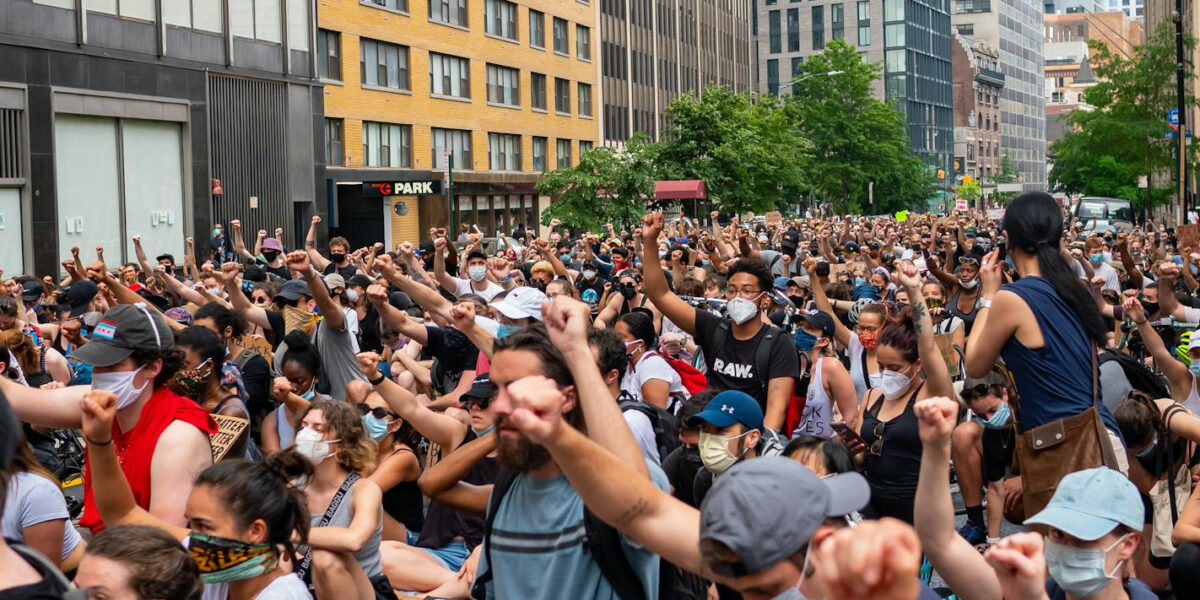
Jahangir Mohammed dissects how Western governments and media treat protests by adversaries and allies. He argues that Western governments cannot credibly claim that protest abroad reveals repression while insisting that protest at home reveals extremism and hate, unless the real issue is not protest but power. Those “friends” of Israel in the West, who have consistently called for restrictions and new laws against anti-Israeli genocide protestors, have suddenly become champions of human rights and protest in Iran.
How the West Uses Protests Abroad to Justify Regime Change While Criminalising Protests at Home.
Western governments regularly insist that they defend free speech, peaceful protest, and democratic accountability. Yet their treatment of Palestine-related protests in their own countries over the past two years reveals a stark hypocrisy. The same governments that celebrate protest abroad as proof of repression and justification for regime change increasingly suppress protest at home when it challenges state power (and of their allies). For over two years, pro-Palestinian protests and slogans have been labelled hate marches and deemed a security and terrorism threat. Every legal means to prevent those protesters has been pursued, including the use of terrorism laws. Yet when protests break out in Iran, the West presents itself as the moral vanguard of free speech and human rights around the world.
This contradiction is not accidental. It reflects a strategic logic that determines which dissent is useful and which is dangerous.
Protest Abroad: Evidence of Repression and Case for Intervention
When protests erupt in adversarial states such as Iran, China, Venezuela, and Russia, Western leaders and allied media present them as unmistakable evidence of authoritarian repression. Demonstrations, online activism, and even unrest are treated as:
- proof of popular illegitimacy
- signs of regime fragility, corruption or mismanagement
- justification for sanctions, diplomatic isolation, or calls for political transformation
Protests in Iran are routinely described as “freedom movements” or “popular uprisings”. Online activism (hashtags, viral videos, diaspora amplification) is portrayed as courageous resistance. Western officials condemn internet shutdowns, arrests, and police force as human rights violations, and these images are cited in international forums as evidence that the Iranian state has lost moral authority.
In all cases, protest is treated as political testimony against the government that the people are speaking; therefore, the regime lacks legitimacy.
Protest at Home: A Security Threat, and Public Order Problem
Yet when large-scale regular protests emerge in Western countries against Israel’s genocide in Palestine, the framing is reversed. Peaceful marches, student encampments, sit-ins, and online activism are increasingly treated as:
- Hateful
- Public order/security risks
- Indicators of extremism and antisemitism
- threats to social cohesion
- precursors to violence/terrorism, including chants, slogans and cartoons
- Too much liberalism and a need for laws restricting protests
The United Kingdom
The response has been tangible and often forceful. The UK government designated Palestine Action under terrorism legislation, thereby criminalising even symbolic support. The police arrested hundreds of demonstrators in London for attending rallies opposing the ban. Protesters have even been detained for chants or signs deemed politically inflammatory, even in the absence of violence.
The United States
The response to anti-Israeli genocide protests has been brutal. Police violently cleared student encampments at multiple universities. The most serious crackdown on protests against Israel’s genocide has occurred in the U.S. Protesters have faced felony charges for trespass or property damage, which civil liberties groups argue were selectively enforced. Lawmakers and university donors have publicly called for surveillance, deportation, or blacklisting of activists. Restrictions have been placed on students with a social media history of pro-Palestinian views, and ICE has picked up people from the streets for deportation.
Germany
In Germany, authorities have banned or restricted pro-Palestinian demonstrations in several cities. Foreign activists faced residency consequences and deportation threats, an extraordinary escalation that ties dissent to immigration enforcement.
France
The Police have repeatedly dispersed Palestine solidarity protests using force. Mass arrests and aggressive crowd control tactics have been widely documented by rights groups.
In each of these countries, the language used by authorities frames protests against Israel’s genocide as a risk, radicalisation, and instability rather than democratic expression. Israel itself has seen countless demonstrations in which the police have used violence against Jewish protestors.
Israel
From 2018-2019, peaceful Palestinian protesters in Gaza demanded an end to the 12-year-long Israeli blockade, which the UN called collective punishment (Great March of Return)
Israeli snipers opened fire at protesters during the demonstrations, killing 316 people and injuring over 35,703. This did not get much coverage in Western media, nor was it considered a matter of concern.
Protests by Israelis in Tel Aviv are often dealt with force or brutality, including the use of water cannon.
Muslim Protesters Versus Non-Muslim Protesters.
The disparity is most evident when comparing Muslim and non-Muslim activism. Muslim protesters/activists are more likely to be framed as:
- emotionally driven
- susceptible to extremism/terrorism
- influenced by foreign networks
Non-Muslim activists expressing similar positions are often described as:
- misinformed/used by Muslims
- idealistic
- misguided, misled, but not dangerous
- In alliance with dangerous “Islamists” (Islamo- left alliance)
This asymmetry extends online. Arabic-language posts and Muslim-generated content are disproportionately flagged, removed, or downranked. Arabic and Islamic language or terminology are often mistranslated or placed out of context. Documentation of Palestinian suffering is labelled “graphic” or “inciting,” while official military content is treated as informational or factual. The number of Palestinian dead is always alleged and must be accompanied by “Israel denies or would deny”. The same media treats ridiculously inflated numbers of those killed in Iranian protests as fact, with no government response.
The Strategic Logic
From this pattern, we can establish a consistent rule in Western politics and media:
- Protest is evidence of repression when it weakens adversaries.
- Protest is a security threat when it criticises or seeks to restrain Western governments or their allies.
Western states use protests abroad for:
- proof that sanctions or their other foreign policies are justified
- proof that regimes lack legitimacy
- proof that intervention is morally necessary and justifiable
But at home, protest becomes something to manage, restrict, or even criminalise when it challenges Western or allied policy, especially that of Israel. This is not a failure of principle. It is a selective application of principles.
This double standard, far from supporting democracy, corrodes democratic norms in two ways. First, it strips “free speech” and “right to protest” of any universal meaning, reducing them to conditional, often racial privileges. Second, it teaches Muslim communities a lesson: that their political speech will be tolerated only when it serves power, never when it challenges it. The result is not social cohesion but further alienation; not security but victimisation and distrust.
Conclusion
Western governments cannot credibly claim that protest abroad reveals repression while insisting that protest at home reveals extremism, unless the real issue is not protest but power. Those “friends of Israel” in the West who have consistently been calling for restrictions and new laws against anti-Israeli genocide protestors have suddenly become champions of human rights and protest in Iran.
If dissent is celebrated only when it weakens enemies and punished when it challenges allies, the language of democracy becomes a tool of convenience rather than a matter of principled conviction. Once that happens, the question is no longer whether a protest is violent or peaceful, but whose voice matters at all. This is how it has always been, even under colonial rule.
Leave a Reply