

Jahangir Mohammed of the Ayaan Institute argues that Israel’s attack on Gaza’s infrastructure and environment is a deliberate attempt to eradicate Palestinian existence and a future, constituting a form of ecological and environmental genocide. Palestinians will continue to perish in the coming decades due to the uninhabitable conditions in Gaza.
Scorched Earth, Poisoned Wells: Israel’s Environmental War on Gaza
The definition of genocide extends beyond simply taking lives. It encompasses acts committed with the intent to destroy, wholly or partially, a national group, such as causing severe physical or mental harm and deliberately creating living conditions aimed at leading to its physical eradication. In Gaza, while the world witnesses the devastating human toll, a slow, more insidious aspect of this crisis is emerging: a systematic assault on the environment that ensures suffering will persist for generations after the bombs are gone (in addition to ongoing deaths from injuries, medical conditions, and malnutrition). The data, collected from UN agencies, World Bank evaluations, and scientific research, clearly depict an ecosystem deliberately destroyed, transforming Gaza from a living entity into a toxic, uninhabitable enclosure.
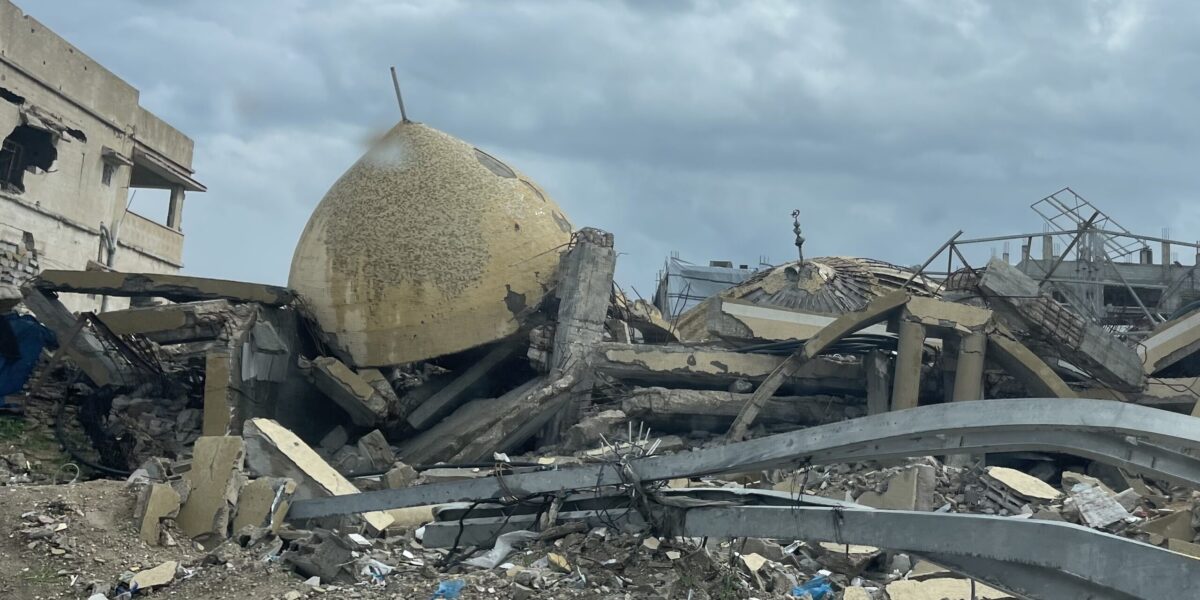
The most visible scar of this conflict is the staggering 53.5 million tonnes of conflict-generated debris that now chokes the landscape. This figure, quantified by the UN by April 2025, is more than just rubble; it is a toxic tomb. Mixed within this enormous volume are hazardous materials like asbestos, unexploded ordnance, and the remains of the deceased. Clearing it is not merely a logistical nightmare but also an environmental hazard, with studies estimating the process could release over 90,000 tonnes of CO₂ emissions, further fuelling the global climate crisis. This debris covers what was once agricultural land, with the FAO (UN Food and Agriculture Organisation) reporting that over 80% of Gaza’s cropland—some 12,537 hectares—has been damaged, and 77.8% is inaccessible to farmers. The deliberate destruction of thousands of olive trees, a symbol of Palestinian heritage and economic sustenance, represents both an immediate economic catastrophe and a long-term ecological blow, stripping the land of its ability to anchor soil and support biodiversity.
Beneath this shattered surface lies an even graver threat: the systematic destruction of Gaza’s water and sanitation systems. This is not incidental damage but a core part of the environmental genocide. The failure of all major wastewater treatment plants has resulted in a tragic daily release of over 100,000 cubic metres of raw or poorly treated sewage into the Mediterranean Sea—equivalent to 43 Olympic-sized swimming pools of waste each day. This intentional act contaminates the coastline, destroys marine life, and devastates the fishing industry, with over 1,000 fishing boats wrecked. The pollution infiltrates the soil and poisons the coastal aquifer, Gaza’s main water source.
Consequently, the data shows that over 90% of Gaza’s water is now unfit for human consumption. The infrastructure collapse is so complete that 85% of water and sanitation systems are inoperable, causing the average water availability to plummet from a pre-war level of 85 litres per person per day to a mere 3-5 litres in some areas—a figure far below any humanitarian emergency standard. This engineered water scarcity forces people to consume contaminated water, directly leading to disease. The World Health Organisation has documented the detection of vaccine-derived poliovirus in sewage and tens of thousands of hepatitis A cases, clear signs of a public health collapse caused by environmental destruction.
The assault on the environment is multi-faceted. The destruction of energy infrastructure has led to a dependence on polluting fuel generators. Simultaneously, damage to solar panels and industrial sites has caused leaks of heavy metals and toxins into the soil and groundwater. The atmosphere itself has become a weapon; scientific analyses confirm spikes in hazardous pollutants like PM2.5, NO₂, and SO₂ from munitions, large fires, and shattered buildings, resulting in acute respiratory illnesses and long-term contamination. This systemic collapse creates a feedback loop of destruction: no power means no water treatment, which allows sewage to flow freely, contaminating land and water, leading to epidemics of disease and making recovery impossible.
This pattern of environmental warfare extends beyond Gaza. Data indicates a regional strategy of ecological destruction. In Lebanon, the use of white phosphorus munitions triggered 812 fires, burning 2.4 million square metres of agricultural land and causing long-term soil contamination. An attack on a fuel depot resulted in a 10,000-ton oil spill into the Mediterranean, while overall ecosystem damage is estimated to have cost $214 million. In Syria, reports detail the complete destruction of the 186-hectare Kodna Forest, a loss valued at $59.5 million, and inspectors found traces of anthropogenic uranium at a bombed site, raising fears of radiological contamination. Even attacks in Iran, beyond the immediate geopolitical context, led to the release of 47,000 tonnes of greenhouse gases from destroyed fuel depots, demonstrating a reckless disregard for transnational environmental health.
The long-term outlook, as warned by UNEP (United Nations Environment Programme), is “unprecedented.” Recovery is expected to take decades, resulting in a lost generation due to poisoning and poverty. The immediate repair cost for critical infrastructure is estimated at $18.5 billion, but full recovery scenarios could reach up to $40 billion. These figures are more than just monetary; they reflect the enormous expense of rebuilding a life-support system from the ground up after it has been deliberately dismantled.
When you destroy the land that sustains a people, poison the water they rely on, and suffocate the air they breathe, you are not just engaging in military conflict. You are enacting a form of annihilation that targets the very future itself. The destruction of Gaza’s environment is a deliberate, slow-burning continuation of violence, designed to render the territory uninhabitable and prevent the Palestinian people from rebuilding a functioning society. It is a war against the fundamental conditions for life, an ecological genocide ensuring that the legacy of death will persist in the soil, water, and broken bodies of survivors for generations. The rubble will eventually be cleared (even that is expected to take decades), but the poisoned wells and barren fields will remain as enduring symbols of a goal that transcends conquest to eradication.
Sources: The article utilises data produced by various reports by the UN and other international and human rights agencies.
Leave a Reply