

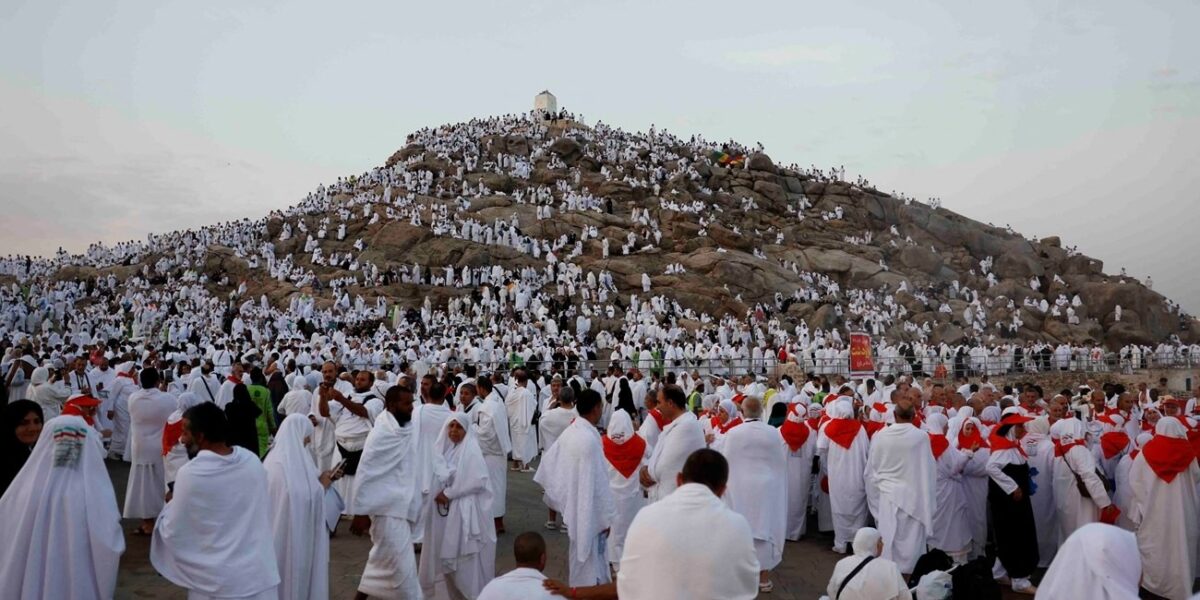
On the day of Arafah, Jahangir Mohammed reflects on the contrast between the Islamic universalism displayed in the Hajj and the horrors of the crimes of Jewish supremacy being broadcast from Jerusalem and Palestine.
The Contrast Between Islamic Universalism at the Hajj and Jewish Supremacy in Jerusalem
The day of Arafah is the pinnacle of the Hajj pilgrimage (5th June 2025), where pilgrims gather at Mount Arafat to seek forgiveness, social and spiritual renewal, and guidance. It is believed to mirror the Day of Judgment, where all humanity stands before Allah (SWT).
The significance of the Hajj goes back to the time of Prophet Ibrahim (Abraham, peace be upon him), whose willingness to sacrifice his son Ismail (Ishmael) was a supreme act of obedience to Allah SWT. It is the story of one of the sons of Ibraham AS, from whom the Prophet Muhammad ﷺ is said to have descended, as opposed to the other son, Ishaq AS (Isaac), from whom the Jewish people claim heritage. It cannot be divorced from, therefore, the story of two peoples and two Holy Lands, as much as two sons. The original direction of prayer for Muslims was Al Quds in Jerusalem.
On this day, Prophet Muhammad ﷺ also gave his Farewell Sermon (Khutbat al-Wada’) at Mount Arafat during his final Hajj. This event emphasised:
- Equality of all races in humanity
- Justice and kindness
- Finality of prophethood
“This day I have perfected your religion for you, completed My favour upon you, and have chosen(completed) for you Islam as your religion.”( Al Quran 5:3)
In 2025, it is poignant to reflect on two powerful, yet starkly contrasting realities we can see today: the universalism of Islam embodied in the Hajj pilgrimage and the ideology and system of Jewish supremacy entrenched in Jerusalem (Al-Quds) and occupied Palestine. These paradigms reveal profound lessons about unity, equality, and the dangers of exclusionary and supremacist ideologies. Hajj is therefore not just a matter of spirituality and ritual but a history and a lesson for humanity at a time of rising ideologies of racial hatred and supremacy.
- Hajj: A Testament to Islamic Universalism
The Hajj pilgrimage, one of Islam’s Five Pillars, is a living manifestation of the unity of humanity. Every year, millions of Muslims—regardless of race, nationality, or social status—converge in Mecca, clad in simple white garments (ihram) to erase visible racial, class and wealth hierarchies. This ritual echoes the Qur’anic ideal: “O mankind, We created you from a single pair… and made you into nations and tribes that you may know one another” (Qur’an 49:13).
- Meaning in Rituals: The Tawaf (circumambulation of the Kaaba) and Sa’i (running between Safa and Marwa) commemorate the legacy of Hajar and Ismail AS, figures revered across Abrahamic faiths. A mother and her child, alone in the desert, seeking water and a land to call home, with no one to come to her aid except Allah SWT. A picture we see in Palestine today. From this land, a great nation/people obedient to Allah SWT eventually emerges. These acts symbolise obedience, spiritual ancestry, collective humility, and faith in God.
- The Farewell Sermon: The Prophet Muhammad’s final Hajj sermon declared, “No Arab is superior to a non-Arab, nor a white person to a black person, except in right conduct”. This ethos is mirrored in Malcolm X’s transformative Hajj experience, where he witnessed “blond-haired, blue-eyed” Muslims worshipping alongside others, dissolving racial divides and in opposition to the white racial supremacy he had seen and experienced all his life in the United States.
- A Model for Humanity: Hajj’s rituals foster obedience to Allah SWT, empathy, sacrifice, equality and global solidarity. A kind of United Nations Assembly of Muslims, transcending racial and geopolitical divides. It is a rejection of ideologies and systems of racial supremacy, regardless of the country in which they exist.
- 2. Jewish Supremacy in Jerusalem: A System of Racial Hatred, Dominance and Division
In stark contrast, Jerusalem—a city sacred to Jews, Muslims, and Christians—has become a focal point of institutionalised racism and inequality under policies prioritising Jewish supremacy and dominance.
- God’s Chosen People: The Zionist (Christian and Jewish) claim that the Jews are the sole inheritors of the land of Palestine and beyond, under some alleged promise from God to only one son of Ibrahim AS (Ishaq AS). In pursuit of this, they endorse the killing of others and the dispossession of their land and properties.
- Legalised Discrimination: Israel’s 2018 Nation-State Law enshrines Jewish supremacy, declaring self-determination “unique to the Jewish people” while marginalising Palestinian citizens and residents. Settlements in occupied territories, deemed illegal under international law, further entrench segregation.
- Apartheid, Persecution and Genocide: The United Nations, rights groups and others document systemic oppression, including restricted movement, unequal access to resources, even water, and demographic control aimed at maintaining Jewish majority rule through external Jewish settlers. Mass murder, slaughter, and theft of other people’s land and properties take place in front of humanity, and in total violation of the ten commandments of Allah revealed through Musa AS.
- Religious and Cultural Erasure: National Security Minister Itamar Ben-Gvir and many supremacists who openly impose Jewish settlers’ rights over Palestinians’ highlight the normalisation of supremacist rhetoric and behaviour in the Holy Land and its religious sites. Whilst Gaza’s entire infrastructure, including hospitals, places of worship and means of livelihood, has been destroyed. Such policies fracture the city’s historic multicultural fabric that had survived for centuries under Muslim rule.
Of course, there are many religious Jews who reject the actions of the Israeli state and its use of Judaism to justify its actions. Still, there are far too many who claim to be acting in accordance with God’s will and commands and currently justifying ethnic cleansing and killing.
- Lessons for Muslims and Humanity
The dichotomy between Hajj’s inclusivity and Jerusalem’s exclusionary regime underscores a fundamental choice: unity and coexistence versus racial hatred and domination. Hajj reminds us that spiritual fulfilment lies in transcending racial and social divisions, while Jerusalem’s reality warns of the moral, social, spiritual and human costs of supremacist ideologies.
Let us draw inspiration from Hajj’s universalism—a call to celebrate diversity, uphold dignity, and reject systems that privilege one racial and class group over another. As the Qur’an teaches, “The most honoured of you in the sight of God is the most righteous” (49:13). Only through such principles can we heal divided cities and souls.
Leave a Reply