

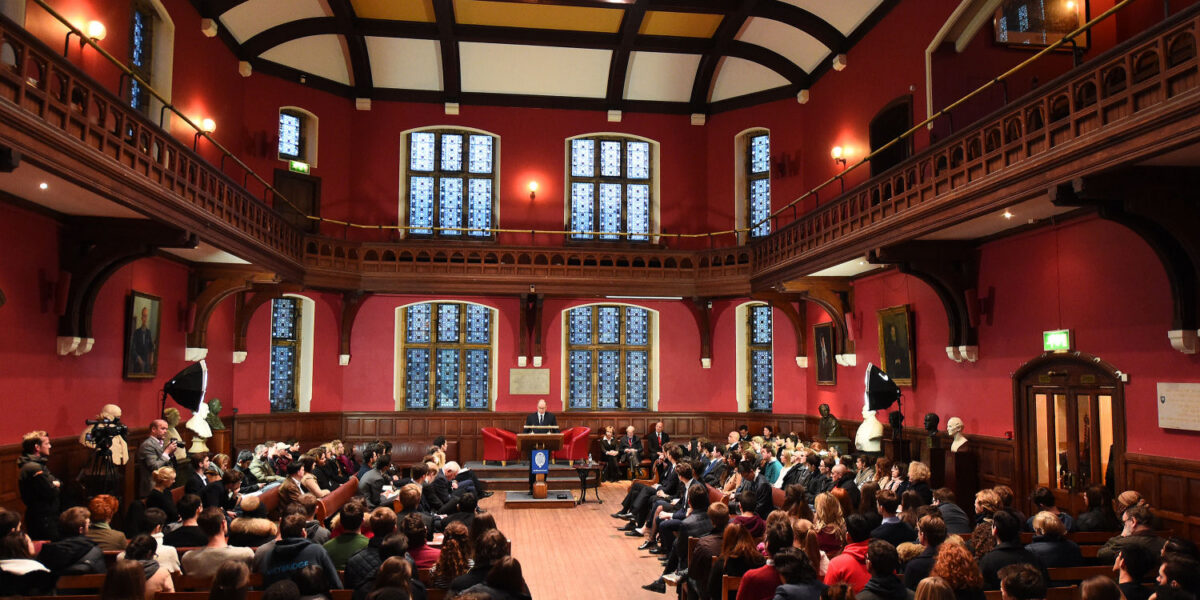
Jahangir Mohammed of the Ayaan Institute argues that the proposed Oxford Union Debate on Islam featuring Tommy Robinson is simply a rehash of previous debates on Islam and Muslims, using the same framing. The Oxford Union merely confirms existing political media biases towards Islam and Muslims, preparing the next generation of political and media elites with the same prejudices and hostility towards Islam and Muslims.
Oxford Union Debates, Anti-Muslim Hate, and the Production of Britain’s Elite
A debate on Islam at the Oxford Union featuring Tommy Robinson has sparked controversy. Robinson is not a public intellectual; his background includes the BNP and EDL, and later affiliations with far-right movements in the US, Israel, and India. The only thing he offers any debate on Islam is hate.
The Oxford Union is no ordinary debating club. It is one of Britain’s most influential elite training grounds, shaping not only British students but also the children of overseas ruling elites. Prime ministers, cabinet ministers, editors, diplomats, judges, and public intellectuals have passed through its chamber. Participation teaches us how the language of power operates.
It matters because elite institutions do not merely reflect public opinion. They shape the language, assumptions, and frameworks through which society understands the world for the next generation of leaders. When you hear a politician or journalist spouting anti-Muslim ideas, they are, more often than not, a product of Oxbridge universities.
Oxford As An Incubator Of Ruling Elites
Oxford University and its Union are part of Britain’s ruling-class pipeline. The Union trains students in political rhetoric, media presentation, and adversarial framing. The University (with Cambridge) provides elite networking that leads to powerful positions, even for untalented children of elites.
Debates, as part of this reproduction system, have consequences beyond the chamber. A motion debated at the Union often foreshadows arguments that appear in newspapers, in parliament, at think tanks, and in policy discussions. The chamber can become a rehearsal room for national discourse. A sitting Union president can use a debate to launch a career in politics or media, as when the current president’s controversial debate was backed by an opinion piece in the Daily Telegraph.
It is also worth noting that Oxbridge is also a recruiting ground for domestic and foreign intelligence agencies.
Elite Discourse and Respectability
Oxford’s significance lies partly in its respectability. When anti-Muslim rhetoric appears on anonymous online accounts, it is dismissed as far-right. When similar suspicions are reframed through a prestigious institution, elite newspapers, or parliamentary language, they gain intellectual legitimacy. Institutions do not always create prejudice; they refine and sanitise it into respectable discourse. Questions once confined to fringe movements become acceptable dinner-table conversation.
Elite institutions often defend themselves from criticism with claims of procedural neutrality – “we debate all sides”. But a neutral procedure does not mean neutral impact. The selection of motions reflects social priorities and reinforces cultural prejudices.
Oxford Union Debates and Bias Against Islam
One striking feature of post-9/11 Western discourse is the transformation of Islam into a “problem to be managed”. Rather than discussing Muslims as citizens or neighbours, institutions often examine Islam through the lens of security, extremism, integration, and compatibility with Western civilisation. Oxford Union debates on Islam reflect this pattern.
Recurring debates about whether Islam is peaceful, democratic, or dangerous normalise the idea that Islam’s legitimacy is perpetually open to public adjudication. Other religions are rarely subjected to the same existential interrogation. This creates a hierarchy: Christianity is culturally native, Judaism is viewed through historical frameworks, Buddhism is exoticised, Hinduism is approached philosophically, but Islam is securitised as a permanent threat.
A serious question arises for the Oxford Union: why does Islam so frequently appear as the subject of suspicion in ways other religions do not?
A Pattern In The Islam Motions
Over two decades, the Oxford Union has repeatedly hosted motions scrutinising Islam. Examples include:
“This House Believes Islam is a Religion of Peace”
“This House Believes Islam is Incompatible with Democracy”
“Islam in Europe”
“This House believes that Islam is incompatible with gender equality”
“This House Believes the West is right to be suspicious of Islam” (May 2026)
There have been at least two other debates since 2000 on religion in general, which included parts with similar narratives on Islam. The current Palestinian-origin president may argue that the current debate is a unique opportunity to challenge anti-Islamic narratives, but records show it is merely a rehash of previous debates.
The framing matters. A debate titled “Is Islam a Religion of Peace?” implicitly places Islam on trial, requiring Muslims to defend their faith against presumptions of violence and belonging.
By contrast, one struggles to find equivalent motions about Christianity’s violence, Judaism’s violence, Hinduism threatening European values, or Buddhism being incompatible with modernity. This asymmetry is hard to ignore.
The Unequal Burden of Suspicion
Christianity, Judaism, Hinduism, and Buddhism have been discussed at Oxford, but usually within broader themes such as organised religion, secularism, or ethics (as in an Oxford debate I once took part in). Islam, however, is more often treated as a geopolitical problem linked to terrorism, extremism, and security stereotypes.
This reflects the post-9/11 atmosphere in Britain and Europe, in which Muslims were associated with a civilisational threat. The Oxford Union did not create this climate, but it has mirrored and legitimised it.
The Problem of “Debating” Your Humanity
Supporters argue that no topic should be immune to scrutiny and that open debate is essential. That principle is valid. But there is a difference between debating ideas and repeatedly putting an already marginalised minority on trial. When motions repeatedly ask whether Islam is compatible with peace or modernity, Muslims are forced into a defensive posture that followers of other religions rarely experience. The debate itself reinforces the notion that Muslims must constantly prove their humanity or belonging.
This is particularly significant in Britain, where anti-Muslim hatred has risen alongside white nationalism and sensationalist media stories, fuelled by far-right online activism. Once framed as “reasonable debate”, loaded assumptions circulate without appearing overtly racist.
Manufacturing the Future Political Class
The Oxford Union shapes future journalists, ministers, and policy advisers in their formative years. Students learn which subjects are controversial, which communities are viewed as threats, what rhetoric attracts applause, and how establishment debate frames minorities. This educational culture shapes how future elites discuss migration, counterterrorism, and multiculturalism. The chamber becomes a political classroom.
Understanding Islamophobia.
Modern Islamophobia is often incorrectly portrayed as fear or personal prejudice. In reality, much anti-Muslim prejudice operates at the institutional and cultural levels. Institutions such as Oxford interact with, reproduce, and legitimise these systems. Even when organisers intend only intellectual controversy, the cumulative effect of debates on Islam reinforces narratives of a Muslim threat, especially when speakers have spent a lifetime hating Islam.
Defenders argue that Christianity has also faced criticism in Britain. This is true. But Christianity has historically held a dominant position as the official state religion. The social consequences are different: a debate questioning Christianity rarely leads to discrimination against Christians in employment, surveillance, or hate crimes. Debates about Islam occur within a much more charged environment.
Free Speech or Selective Scrutiny?
There is no such thing as “neutral free speech”. Free speech cannot be separated from social position and power. Formal equal treatment can still produce unequal effects.
These Oxford debates on Islam are ultimately about power. When Islam is uniquely framed as questionable on peace, democracy, or civilisation, the issue is not free speech, the right to offence, but the reproduction of elite assumptions that influence politics, media, and public consciousness for generations.
The Oxford Union is influential because it trains those who will later define “reasonable opinion” in Britain. That is why its debates matter far beyond Oxford’s campus.
The issue is not whether Islam should ever be criticised. Every religion can be questioned. The issue is whether Islam is treated differently, not merely criticised, but continually cast as a civilisational suspect and threat.
The real question the Oxford Union may one day need to debate is whether Oxbridge universities themselves contribute disproportionately to a pipeline of prejudices, producing racist and anti-Muslim haters who end up in politics and the media.
Leave a Reply